The final keyword in Java

final doesn't guarantee that your object state is immutable
A final variable can be assigned only once but the state the object referenced by the variable can change.
This could be particular dangerous with collections if the developer assume that the values cannot be changed.
The final variable will reference always the same Collection Object but it will be possible to add and remove values.
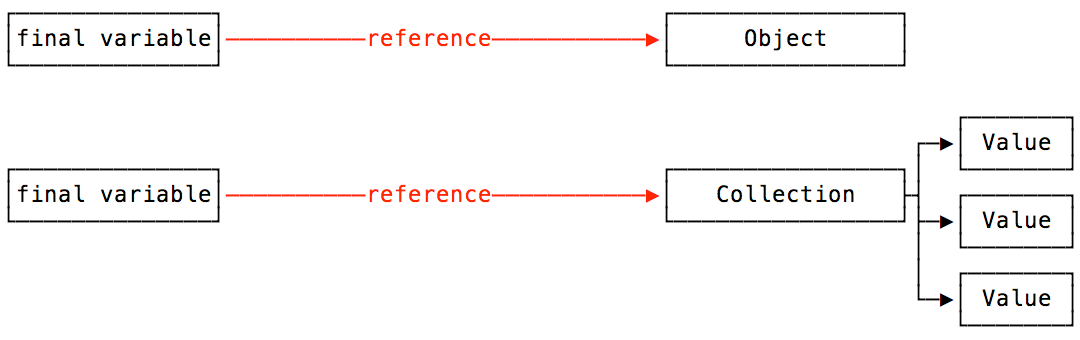
The red reference cannot be changed (final). The values of the collection can change. The final keyword refers to the reference and not to the object.
final and performance gain ?
The use of final is intended mainly has good practice during the development phase to avoid that variables are modified accidentally.
In theory the JVM implementation could optimise the compiled code improving the performance of final variables during the runtime, e.g. avoid the synchronisation.
The performance gains are only assumptions and the performances could change with every new release of the JVM, for this reason the final variable should be used only with the goal of improving the quality of the code.
the performance benefit gained by declaring a method or class as final is usually zero
Brian Goetz, 2002
final keyword and effectively final variables and parameters
For some local variables you don't need to specify the keyword final, the JVM assumes this variable is (effectively) final if:
- it is not declared final
- it is not assigned (beside the declaration)
- it is not incremented (++) or decremented (--) using pre- and postfix operators
The same rules are applied to the parameters of methods, constructors, lambda and exceptions. The JVM treats these parameters as local variables to determine if they are effectively final.
when final and effectively final variables are mandatory to avoid exceptions? inner classes: outer classes variables used in inner classes lambda: variables of the enclosing scope used in the lambda body
Optimization
final methods are candidates for an inline optimization done by the compiler. But only private methods can be safely inlined, for this reason the final keyword is redundant.
final fields can be optimized by the compiler, e.g. caching the value in a register.
When to use the final keyword
In my experience, final is vastly overused for classes and methods (generally because developers mistakenly believe it will enhance performance), and underused where it will do the most good -- in declaring class instance variables.
Brian Goetz, 2002
with final classes and methods you should always ask yourself if you really need to use final. With final fields, you should ask yourself the opposite question -- does this field really need to be mutable? You might be surprised at how often the answer is no.
Brian Goetz, 2002
The recommendation is to use the final for fields that won't change value. The use for classes and methods should be exceptional and documented.
The final keyword guarantees that a field is initialized before to be accessed by a different thread.
Make all fields final.
Joshua Bloch, Effective Java
The Oracle Java Tutorial suggests to declare final the methods called by a constructor, to avoid unexpected results in subclasses.
Java Exceptions
Local variable defined in an enclosing scope must be final or effectively final
Links
- Language Specifications: https://docs.oracle.com/javase/specs/jls/se11/html/jls-17.html#jls-17.5
- Discussion about the corner case of the specification https://stackoverflow.com/questions/5066866/testing-initialization-safety-of-final-fields/15517168#15517168
- Brian Goetz on the final keyword, 2002