Linux and AI (potential) Slop

For some rational or irrational reasons you or your company want to avoid or reduce the AI slop that could come with Linux. The policies adopted by each distribution can become an important factor in deciding which distribution to use.
TL;DR
You want to avoid AI generated code in your Linux distribution? No chances, the Linux Kernel is permissive, but if you want support Distribution that for legal, technical and ethical reasons refuse to have AI / LLM contributions Gentoo, Asahi, and Elementary OS deserve your attention.
Overview October 2026
LK : Linux Kernel (aka Linus the King)


You could adopt an AI free distribution, but you have to remember that Linus adopted and allowed the usage of AI for the maintenance of the kernel. You can call it 'responsible' or 'slop', the distinction is personal, but Linux will contain AI generated code in any distribution.
Overview
| Distribution | AI-generated code contributions |
|---|---|
| Gentoo | 🔴 Prohibited |
| elementary OS | 🔴 Prohibited |
| Asahi Linux | 🔴 Prohibited |
| Linux Mint | ⚪ No explicit policy found |
| openSUSE | ⚪ No explicit policy found |
| Ubuntu | ⚪ No explicit policy found |
| Fedora | 🟢 Allowed |
| Debian | 🟢 Allowed |
No AI
Gentoo Linux


Gentoo Council adopted a resolution in 2024 that clearly refuses AI contributions:
It is expressly forbidden to contribute to Gentoo any content that has been created with the assistance of Natural Language Processing artificial intelligence tools. This motion can be revisited, should a case be made for such a tool that does not pose copyright, ethical and quality concerns.
You cannot even use AI for assistance! Interestingly the policy is not limited to copyrights and quality concerns, but it is extended to ethical issues too:
The business side of AI boom is creating serious ethical concerns. Among them:
Commercial AI projects are frequently indulging in blatant copyright violations to train their models.
Their operations are causing concerns about the huge use of energy and water.
The advertising and use of AI models has caused a significant harm to employees and reduction of service quality.
LLMs have been empowering all kinds of spam and scam efforts.
Asahi Linux


Asahi like to Gentoo mentions many factors as reasons to forbid the use of LLM for the development of the distribution:
LLMs engender harms to the pillars of Asahi Linux: software freedom, the open-source community, the open Internet, the environment, digital privacy, user consent, and software developers themselves.
Asahi adds as a risk factor the reverse engineering required to ensure that the distribution runs on Apple machines and this activity has particular legal implications and risks.
Asahi doesn't allow any LLM based contribution:
we broadly forbid the use of generative AI tooling for material contributions to Asahi Linux
With the possibility of the exclusion from the community:
A contributor found to have concealed extensive LLM use will be banned immediately, particularly if they may have accessed unreleased Apple material.
The question many are thinking is ... Asahi is based on Fedora ... is Fedora LLM Free?
Elementary OS

Elementary OS takes the same stance about LLM, like Asahi and Gentoo the reasons are mainly: Quality, Legal, Ethical.
This project does not allow contributions generated by large languages models (LLMs) and chatbots. This ban includes tools like ChatGPT, Claude, Copilot, DeepSeek, and Devin AI and it applies to all parts of the project, including, but not limited to, code, documentation, issues, and artworks.
Ethical concerns including but not limited to those regarding intellectual property theft, environmental impact, externalities that primarily impact already-marginalized groups, devaluing labor for the purpose of concentrating power among the billionaire class, etc.
An exception is allowed for the discussion between participants, they are allowed to use a translator to simplify the communication.
AI Accepted
IBM/RedHat Fedora Linux


To answer to the Asahi question, Fedora allows the use of LLMs and discloses it only when significant part of the contribution is taken from a tool without changes.
This limitation is so generic that technically adding a space to the code allows you to not declare the LLM origin.
Debian

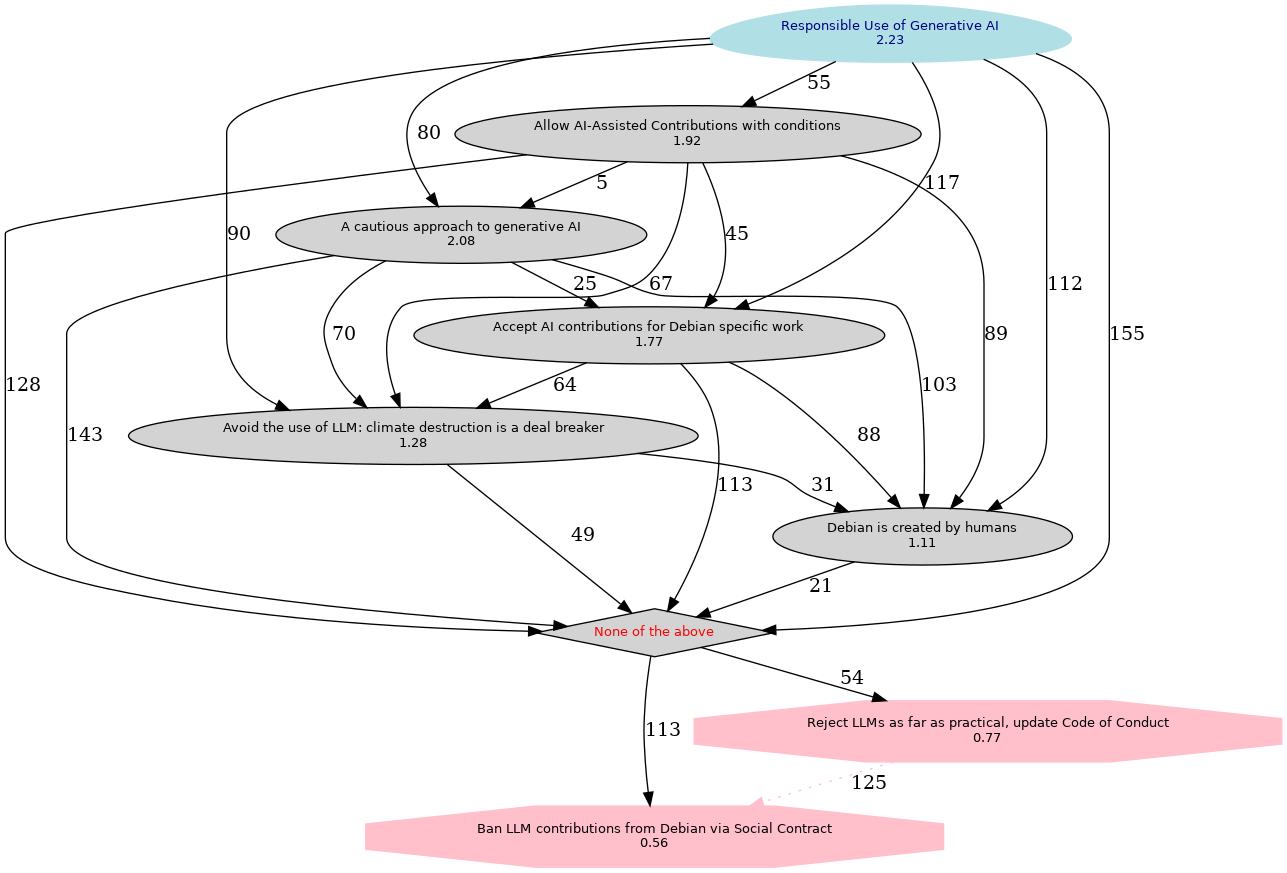
The traditional (and conservative) 'rock solid' reference of the Linux distributions had a vote about the use of LLM, the winning position leave the responsibility of the decision to the individual participants.
This resolution therefore affirms that generative AI is neither exempt from nor subject to special rules beyond the standards already expected of Debian contributors. The responsibility for every contribution rests with the contributor who submits it, who remains accountable for its technical quality, legal acceptability, and suitability for inclusion in Debian.
Interestingly, compared to other distribution there is no mention to ethical principles. The warnings are mostly about potential legal issues. An LLM could have generated this resolution.
NixOS


Here again, responsibility of the individual and mention LLM only for non-trivial use of automation.
Every contribution to Nixpkgs and related development venues, including code, documentation, and communication on GitHub and Matrix, must have a responsible person in the loop who is accountable for that contribution and reviews it before submission, and must transparently disclose any non‐trivial use of automation to produce it, including but not limited to LLM‐based AI tools.
No explicit Policy
I didn't find any explicit policy for these distributions, if you know that they have a formal position, send me a message, please.
Arch Linux
I found a recent debate about this topic in the forum: https://bbs.archlinux.org/viewtopic.php?id=314112.
Ubuntu
Ubuntu is commercially promoting the advantages of their distribution for AI related activities, this doesn't mean that they accept LLM contribution.
I found an indication in the guidelines for the documentation contribution.


In summary, you can use LLM as a grammar checker etc. but you cannot use it to produce documents and LLM generated contributions will be refused. Human typos are, on the other side, welcome.
About the project:
There is a mention of the 'responsible adoption of AI' (https://discourse.ubuntu.com/t/ubuntu-governance-meeting-sync-notes-8-sep-2026/88301), but this is more oriented towards the AI tools integrated in the distribution (privacy first and local tools) than rules for the developers.
Linux Mint
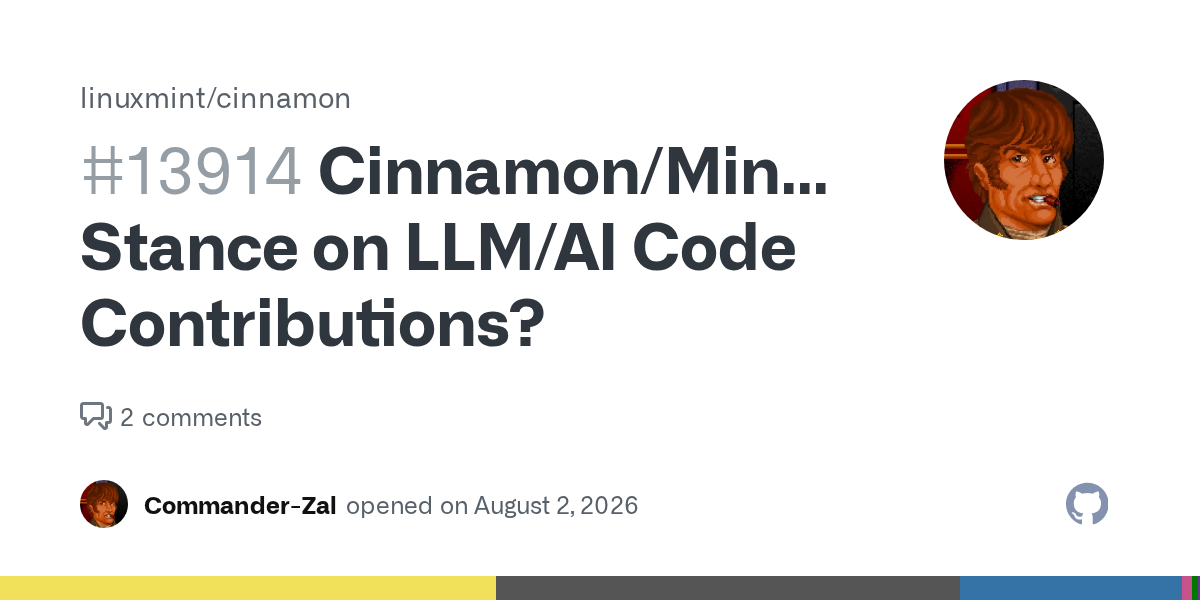
No position. There is this open issue about LLM for Cinnamon without an answer:
 Commander-Zal
OpenSuse
Not clear.